




.svg)

Walkout Basement Ideas Toronto
A walkout basement is a structural investment in grading and light, not a cosmetic renovation. Most homeowners in the GTA recognize the rental...
11 min read
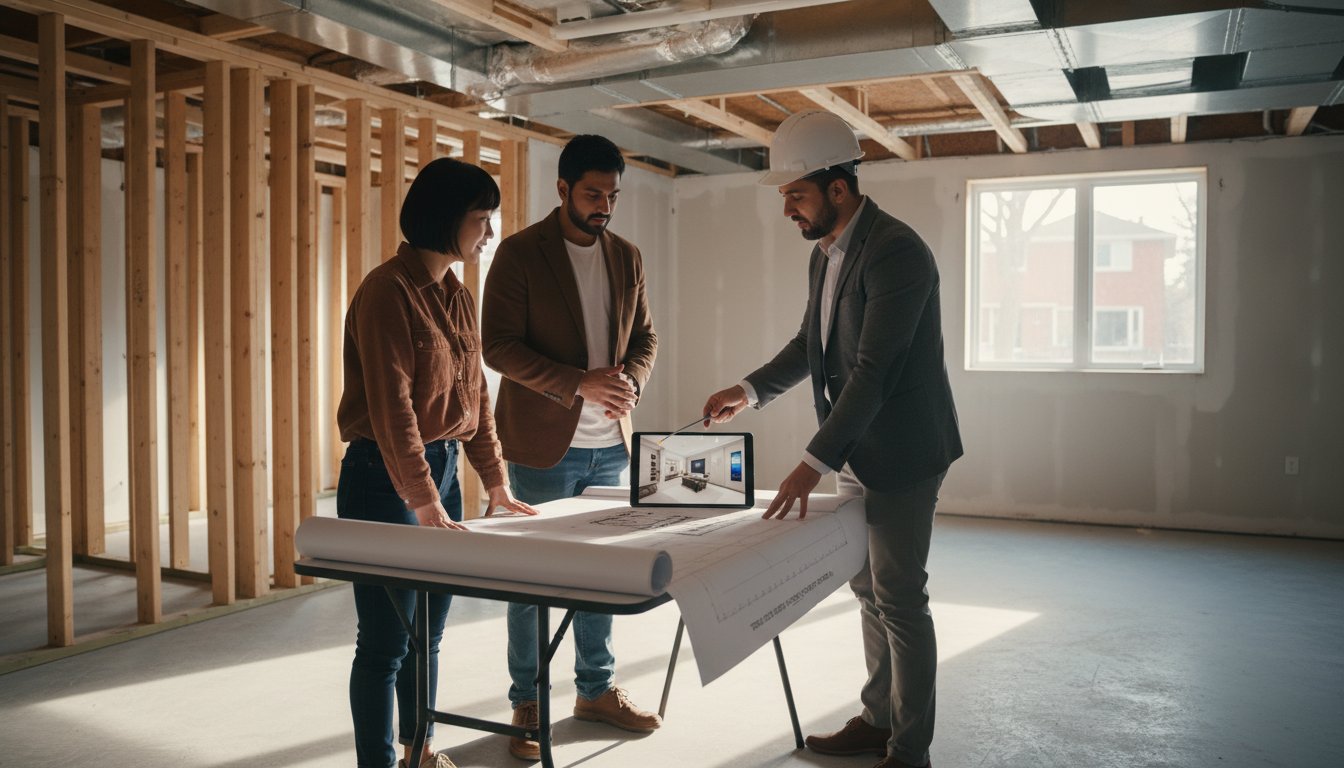
Most toronto basement renovation projects fail before the first sledgehammer swings because they start with a guess instead of a logic-driven plan. You've likely heard the horror stories of contractors vanishing halfway through a job in Oshawa or surprise invoices appearing mid-project in Whitby. It's a chaotic industry where vague estimates are the norm and homeowners often bear the risk of poor planning and regulatory oversight. Guesswork has no place in your home.
We believe your property deserves a strategy, not a gamble. This guide provides a no-nonsense framework to ensure your project is legal, code-compliant, and finishes on budget without the typical GTA industry delays. We prioritize financial predictability through our BCR Promise, which includes a Fixed-Price Guarantee to ensure you never face a budget surprise. We'll walk you through the essential checklist for securing permits in municipalities like Ajax and Pickering, meeting 2026 Ontario Building Code requirements, and ensuring your project is a viable investment. You are about to learn how to move from a state of worry to a state of informed confidence by treating your renovation as a structured financial calculation.
A toronto basement renovation often collapses under the weight of a lowball quote. Many contractors provide a "back of the napkin" number that ignores the structural reality of your home just to get a deposit. This is a trap. A successful project isn't just about new paint; it's a project that meets building codes, stays on budget, and finishes on time. If a quote seems too good to be true, it's because the contractor hasn't accounted for the actual costs of a legal, safe build.
Poorly planned HVAC and plumbing systems are the most common culprits for post-renovation regret in the GTA. If your contractor doesn't account for the extra load on your furnace or the specific drainage requirements for a new basement bathroom, you will face expensive repairs within two years. We see this constantly in older Toronto homes where existing infrastructure wasn't designed for a modern basement kitchen or home theatre. You need a plan that respects the physics of your house.
To see what a properly managed transformation looks like, watch this full basement overhaul:
Guessing at structural loads is the fastest way to get your permit rejected by the City of Toronto. A cosmetic refresh is easy, but a structural overhaul requires precision. In neighbourhoods like Scarborough, older foundations often need specific reinforcement before you can safely add an in-law suite or a gym. Skipping the planning phase usually leads to at least $20,000 in unplanned expenses. This is why we insist on a Paid Basement Feasibility Assessment ($697) before we ever sign a construction contract. It protects your time and your bank account.
Contractors walk off jobs when they realize they've underquoted and are losing money. It's a systemic issue in the GTA. When a "handshake deal" meets a structural complication, the contractor disappears because they don't have the margin to fix the problem. We eliminate this incentive through the BCR Promise. Our Fixed-Price Guarantee means the price we agree on is the price you pay. We take the risk of the unknown so you don't have to. Real certainty comes from a structured operational framework, not a vague estimate. If you want to see where your budget should actually sit, use the Basement Cost Calculator at bcrdesignbuild.com.
A finished basement is a room with drywall. A legal basement apartment is a life-safety infrastructure project. For a toronto basement renovation to be considered a legal second suite in 2026, it must meet rigorous Ontario Building Code (OBC) standards that many "handyman" contractors ignore. Fire separation is the biggest hurdle; you need a 30-minute fire-rated separation between the units. Ceiling heights must be at least 1.95 metres for most of the living space, and bedrooms require egress windows with a minimum opening of 0.35 square metres and a minimum dimension of 380mm. If a contractor tells you these are optional, they're putting your family and your investment at risk.
The Electrical Safety Authority (ESA) also plays a non-negotiable role. Every wire pulled must be inspected and certified. Cutting corners here doesn't just invalidate your home insurance; it creates a genuine fire hazard. Understanding your consumer rights for home renovations is a critical first step before signing any contract that bypasses these legal requirements. A legal toronto basement renovation requires a paper trail of inspections to hold its value at resale.
Permit requirements vary significantly across the GTA. In the City of Toronto, expect to pay roughly $11.09 per square metre for permit fees in 2026. If you are in Oshawa or Whitby, the fees and zoning bylaws regarding parking and lot size differ. In 2026, permit approval timelines range from 2 to 8 weeks depending on the specific municipality. We handle the entire permitting process, including architectural drawings, because your time is too valuable to spend at a municipal planning desk.
Legal suites require independent heating and ventilation. You can't simply cut a vent into the existing ductwork and expect it to meet code or provide comfort for a tenant. We also insist on backwater valve installation for every project. It's a non-negotiable for basement flood prevention in the GTA. If you're adding a basement bathroom, you must also solve low water pressure in house lines before we finish the walls. Adding high-end fixtures to a system with poor pressure is a waste of money. If you aren't sure if your space is viable, book a free Planning Call to discuss the structural logic of your home.
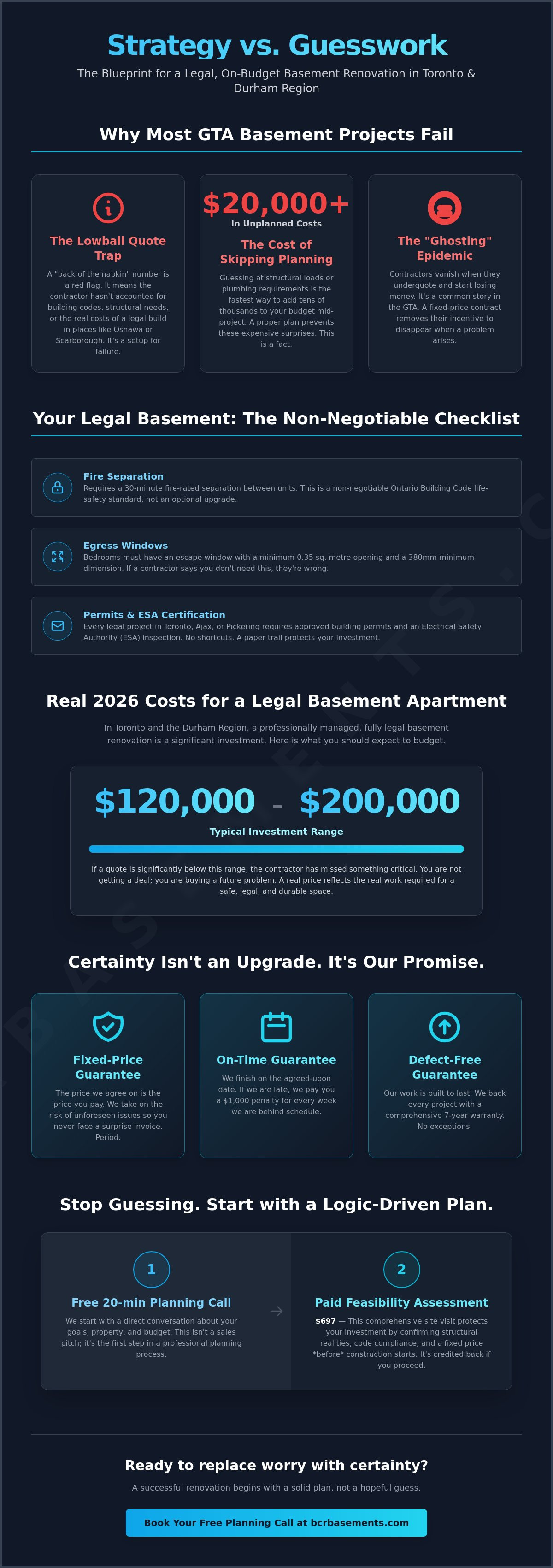
A professional toronto basement renovation in 2026 requires a realistic financial commitment. Forget the lowball quotes of $40,000 you see on social media; they aren't based on the structural reality of the GTA market. Current rates for finishing a basement properly range from $75 to $150 per square foot. If you are building a legal basement apartment, expect a total investment between $120,000 and $200,000. These figures reflect the rising costs of specialized trade labour and the high standards of the Ontario Building Code. Professional work costs more because it lasts longer.
Demand in Durham Region has pushed prices in Ajax and Pickering closer to Toronto averages. Homeowners in these areas are increasingly investing in high-yield secondary suites to offset mortgage costs. In Toronto proper, you must also account for the "hidden" costs of older homes. If your ceiling height is below the 1.95-metre requirement, you will need underpinning or benching to create a legal space. This adds significant structural complexity and cost. You can check the official City of Toronto permit requirements to see if your structural changes trigger a mandatory permit. Never skip this step to save money.
We do not use time-and-materials contracts because they shift all the financial risk onto you. Contractors who work this way often provide "allowances" for materials that are intentionally set too low. When you pick your actual flooring or tiles, the price jumps, and you're stuck with a surprise invoice. We use a fixed-price model. Once we complete our $697 Feasibility Assessment, the price we give you is final. You deserve financial certainty. To get a baseline for your project, use the Basement Cost Calculator at bcrdesignbuild.com.
A legal suite in Toronto can generate $2,300 to $2,600 in monthly rental income. This makes the initial investment a logical financial calculation rather than a cosmetic expense. To command top-tier rent, you need to prioritize natural light and open layouts. Small, dark windows and cramped hallways will limit your return. We focus on designs that maximize the "feel" of the space to attract high-quality tenants. You can see how we handle these layouts in our Basement for rent in Toronto: Design Examples. If the logic of the project doesn't work for your budget, we'll tell you. We value your long-term investment over a quick sale.
Vetting a contractor for your toronto basement renovation requires a checklist of objective facts, not a gut feeling about their personality. You must demand proof of $5M liability insurance and current WSIB compliance before anyone steps onto your property. If a worker is injured and the contractor isn't covered, the financial liability falls on you as the homeowner. This isn't a risk worth taking to save a few dollars. Professional firms operate with these safeguards as a baseline requirement, not an optional extra.
Social proof is your next filter. Look for a 4.7-star rating across at least 43 verified Google reviews to ensure the company has a consistent track record of delivering what they promise. Many contractors can finish one job well; few can maintain a high standard across dozens of projects in the GTA. If they can't show you a history of satisfied clients, they're practising on your home. You need a partner who has already solved the problems your project will inevitably present.
We don't ask for your trust; we earn it through three written guarantees that form the BCR Promise. First is our Fixed-Price Guarantee. Once the $697 Feasibility Assessment is done, the price is locked. You will not receive surprise invoices mid-project. Second is our On-Time Guarantee. If we are late, we pay you a $1,000 penalty for every week past the deadline. Finally, our Defect-Free Guarantee provides a 7-year warranty on our craftsmanship. These are financial commitments that hold us accountable to your timeline and budget.
Ask a potential hire: "Will you pull the permits in your name or mine?" If they say "yours," walk away immediately. A contractor who asks you to pull a permit as the homeowner is trying to avoid being held responsible for the work by municipal inspectors. You should also ask how they handle Ontario Building Code fire separation requirements. If they can't explain the specific materials and methods required for a legal suite, they aren't qualified for the job. You can see how we stack up against others in this guide on Basement Remodeling Companies: Comparing Services. Don't settle for a contractor who won't put their promises in writing. Book a free Planning Call at bcrdesignbuild.com.
We don't offer "free estimates" because they are the root of most toronto basement renovation nightmares. A free visit is usually a high-pressure sales tactic designed to get a deposit, not a structural analysis of your foundation or HVAC capacity. Real planning requires hours of professional work, site measurements, and code verification. We refuse to participate in the industry habit of guessing at numbers. We prioritize your budget's safety over a quick sale. Guesswork is how projects fail.
Your journey with us begins with a Free 20-minute Planning Call to determine the basic viability of your project. This is where we discuss your vision and your budget to see if they align with the reality of building in the GTA. If you are looking for a legal basement apartment in Oshawa or a high-end home theatre in Whitby, we need to know if the house can support it. This call protects your time by ensuring we are the right fit before any money changes hands. It's about data, not persuasion.
The $697 Basement Feasibility Assessment is a non-negotiable roadmap for your home. We perform a comprehensive site review and create a preliminary design layout that respects the structural logic of your property. You receive a guaranteed fixed-price quote that will not change. This eliminates the "lowball quote trap" and ensures you have financial certainty before construction starts. If you decide to proceed with the build, the $697 is credited back to your project. This professional service is essentially free for our clients. It's a small investment that prevents $20,000 mistakes.
Organize your priorities before you book your Planning Call. Decide whether you want a basement kitchen for an in-law suite or a basement bar for entertaining. These choices dictate the plumbing and electrical requirements we must account for during the assessment. In the Durham Region, legal suites are becoming high-value assets that significantly offset mortgage costs. You need to decide if you want a space for personal use or a rental unit that commands top-tier Toronto rent. Clarity at this stage ensures the design matches your long-term goals.
Just as a professional renovation protects your home's equity, expert maintenance of your vehicle preserves its resale value. For homeowners in the GTA who value a meticulous finish, Nanak Car Wash provides the same level of detailed care for your car as a professional contractor provides for your basement.
Read The Homeowner’s Guide to Basement Builders in the GTA to understand how to vet your options. We are focused on providing a legal, code-compliant living space that stands the test of time. Your toronto basement renovation should be a source of financial peace, not a series of contractor nightmares. Book a free Planning Call at bcrdesignbuild.com.
A successful toronto basement renovation requires moving past the "cheap quote" mentality and embracing a data-driven process. You now understand that legal fire separation, specific ceiling heights, and professional permits are the only ways to protect your home's value. Vague estimates and handshake deals are the primary causes of project failure in the GTA. You don't have to accept that chaos as the industry standard. Real certainty comes from a structured plan.
We provide the stability you need through the BCR Promise. Our Fixed-Price Guarantee eliminates surprise invoices; our $1,000 per week On-Time Guarantee ensures we respect your schedule. This disciplined approach is why we maintain a 4.7-star rating across 43 verified Google reviews. We treat every project as a strategic financial calculation rather than a series of guesses. It's time to build with confidence.
Book a free 20-minute Planning Call at bcrdesignbuild.com to determine if your basement project is a viable investment. We look forward to helping you turn your vision into a legal, high-return reality.
You absolutely need a permit for any toronto basement renovation that involves structural changes, new plumbing, or electrical work. Municipalities like Toronto, Ajax, and Pickering require these to ensure the space meets the Ontario Building Code and is safe for occupancy. Skipping permits might save time initially, but it makes your home uninsurable and difficult to sell. We handle the entire permitting process as part of our structured workflow to protect your investment.
A professional, code-compliant legal basement apartment in the GTA typically costs between $120,000 and $200,000 in 2026. This range covers the specialized fire separation, separate entrances, and independent HVAC systems required by provincial law. While you may find lower quotes, they often omit the structural logic needed for a legal suite. We provide a final, fixed price after our $697 Feasibility Assessment to ensure you have total financial certainty.
Underpinning involves digging beneath your existing foundation to extend the walls downward, while benching creates a concrete "step" or bench inside the basement to support the foundation. Underpinning maximizes your square footage but is more labour-intensive and expensive. Benching is faster but reduces the usable floor area. The right choice depends on your specific goals, whether you are building a rental unit or a home theatre, and your total budget.
You can build a basement kitchen for personal use, but it does not automatically make the space a legal second suite. To be considered legal, the unit must meet specific fire separation, egress, and parking requirements set by your municipality, such as Whitby or Oshawa. Adding a kitchen without a permit is a major risk that can lead to municipal fines. We focus on ensuring every kitchen installation is part of a viable, code-compliant plan.
Most professional basement finishing projects take between 8 and 12 weeks once permits are issued. Complex jobs like legal suites or those requiring underpinning can take significantly longer. We provide a written On-Time Guarantee that pays you $1,000 for every week we are late. This financial penalty keeps us accountable to your timeline. Efficiency comes from our disciplined operational framework, not from cutting corners during the construction phase.
With most GTA contractors, you are responsible for budget overruns caused by poor planning or "allowances." We eliminate this uncertainty with our Fixed-Price Guarantee. Once we complete your Feasibility Assessment, the price is locked. If we miss something in the initial plan, we cover the cost, not you. This is why we don't offer "free estimates" that lead to surprise invoices; we value precision over a quick sale.
Your basement must have a minimum ceiling height of 1.95 metres for most of the floor area to meet the Ontario Building Code for a legal suite. If your current height is lower, you will need to consider underpinning or benching to reach compliance. We verify these measurements during our $697 Feasibility Assessment. If the structural logic of the project doesn't work for your home, we will tell you before you spend any money on construction.
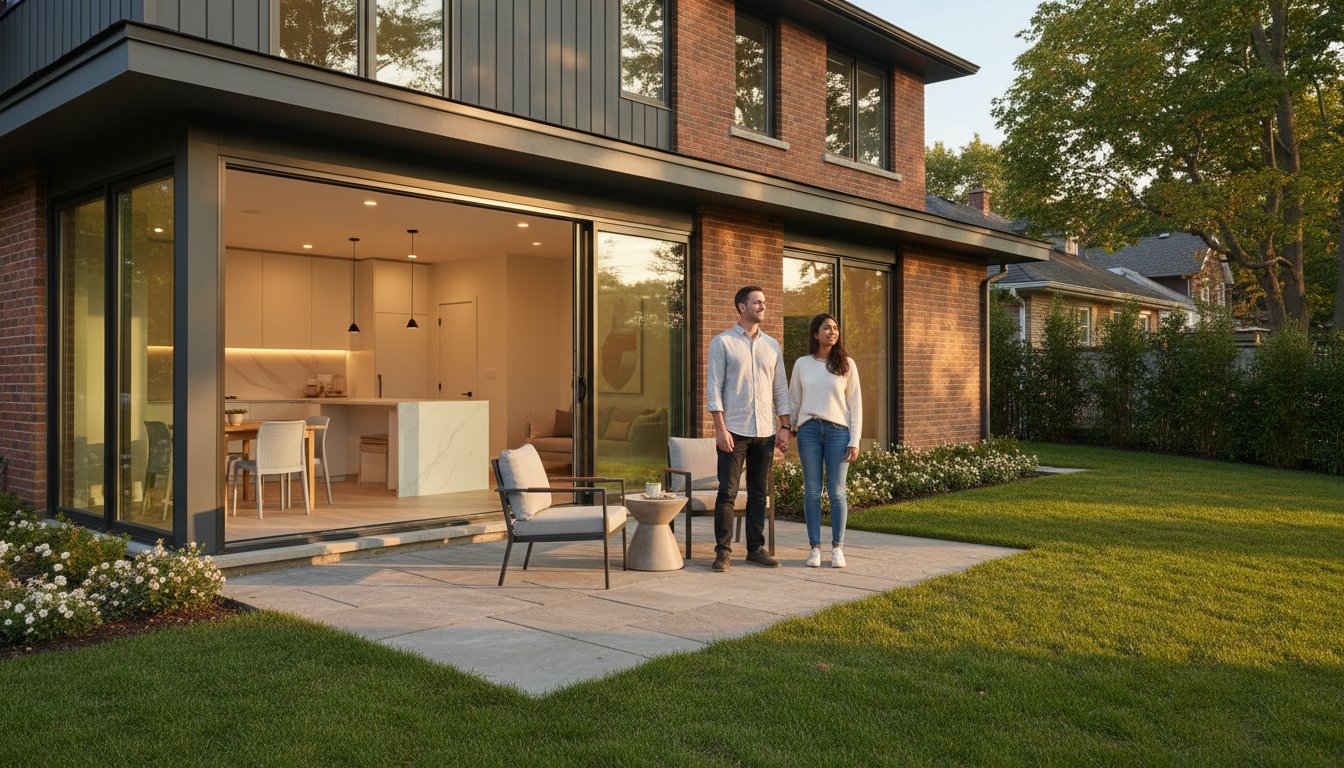
A walkout basement is a structural investment in grading and light, not a cosmetic renovation. Most homeowners in the GTA recognize the rental...
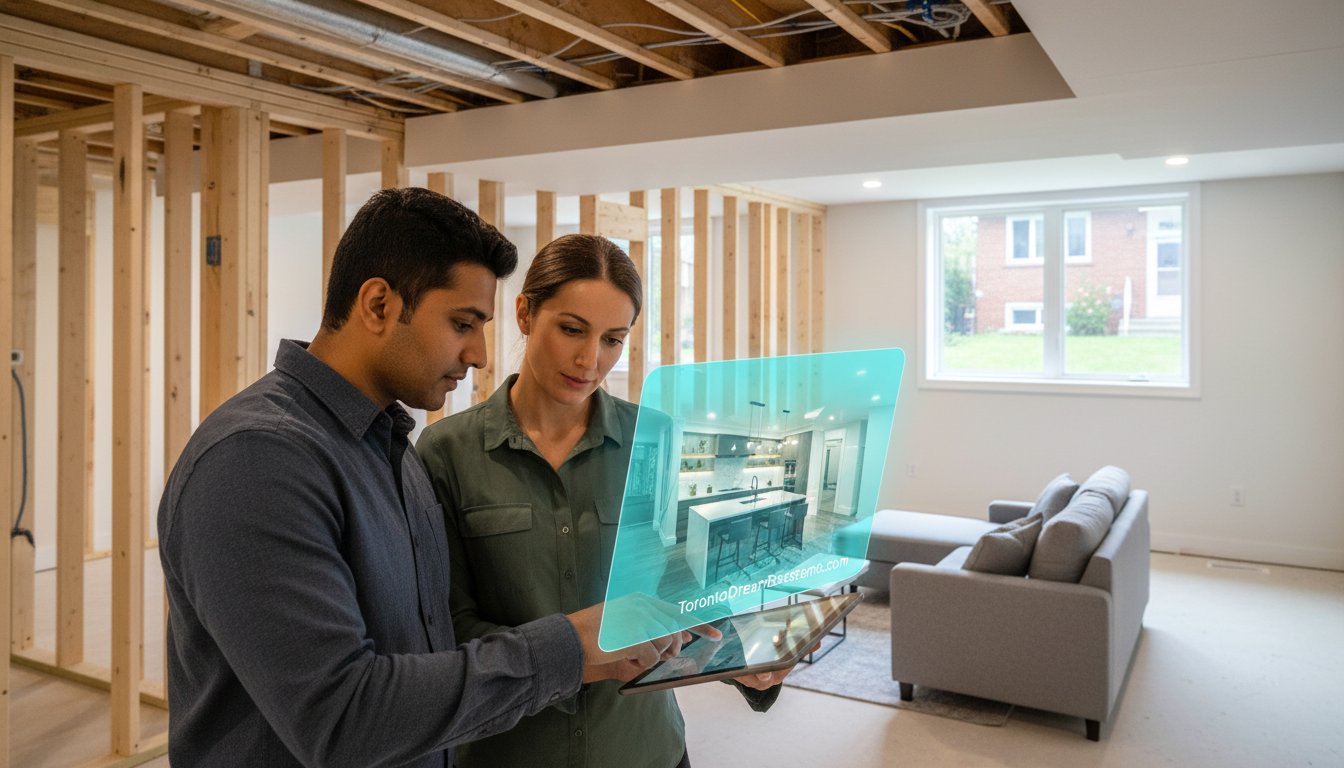
Most basement quotes you receive in the GTA are intentionally low because they aren't designed to be final. You likely already know that the...
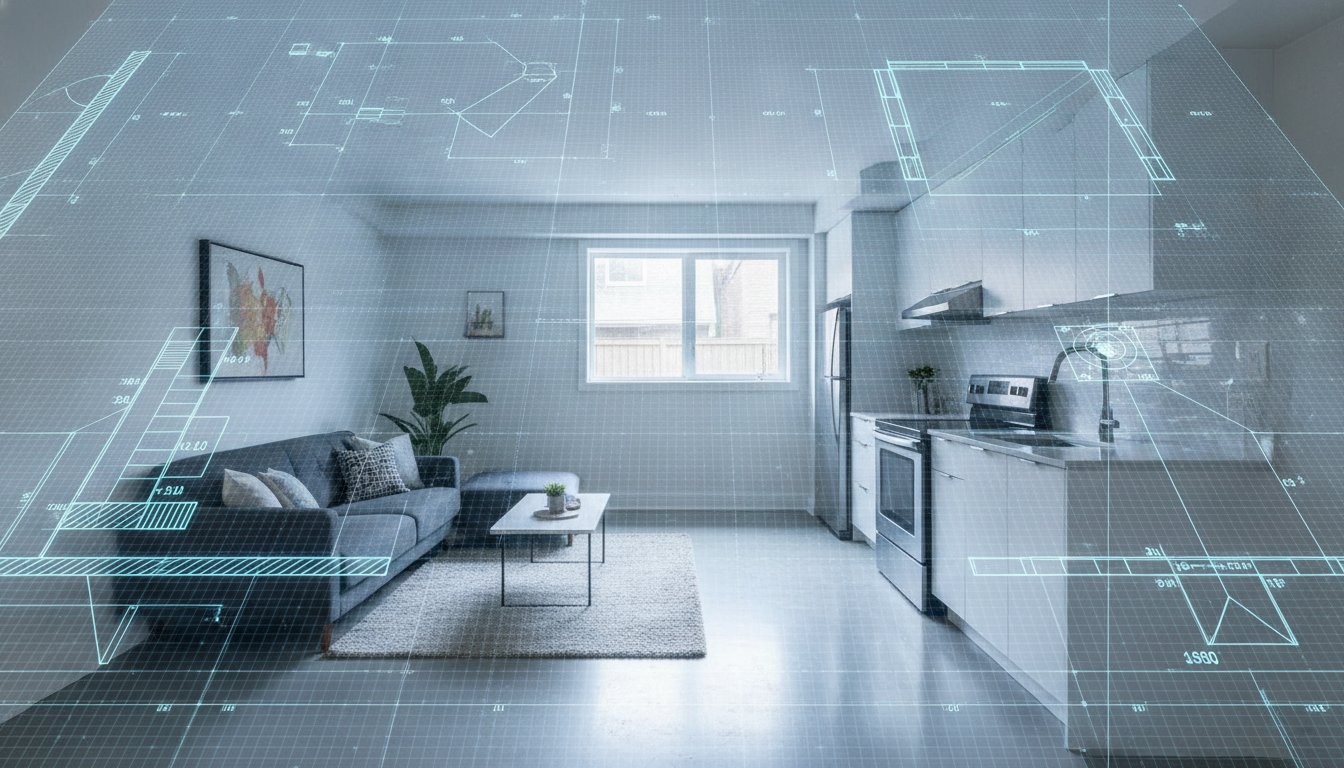
Most basement quotes in the GTA are built on guesswork, not structural logic. If a contractor gives you a price without accounting for Toronto's 2026...