




.svg)

11 min read
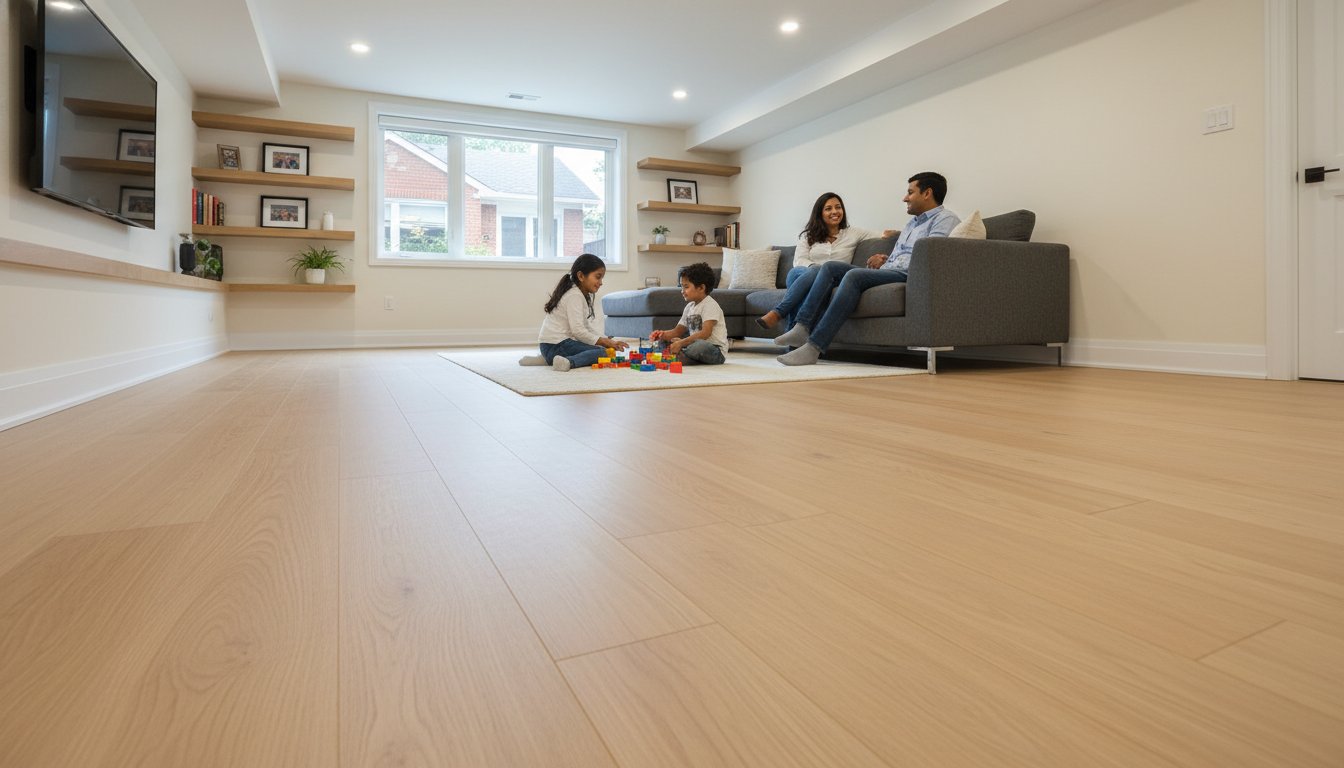
Most basement flooring choices in the GTA fail because they prioritize aesthetics over the engineering realities of a concrete slab. In Toronto, your floor is a moisture management system first and a design choice second. If you ignore the physics of ground temperature and humidity, your investment will warp or grow mould.
We understand the fear of a heavy rainstorm ruining your renovation in Whitby or Oshawa. You want a durable space that meets the 2024 Ontario Building Code for a legal suite. This guide breaks down the best basement flooring options for the Durham Region climate, focusing on moisture protection and structural logic. We will show you which materials actually work in our environment and how our BCR Promise provides financial predictability through a fixed-price guarantee. No surprises. No hidden fees. Before you commit, we recommend booking a 20-minute Planning Call followed by a Basement Feasibility Assessment to ensure your project is viable and protected from the start.
Key Takeaways
- Understand why the GTA’s specific climate and porous concrete make moisture management your first priority before choosing any material.
- Learn why we treat a proper subfloor as a non-negotiable insurance policy to protect your finished floors from mould and moisture.
- Discover why Luxury Vinyl Plank is the 2026 gold standard for basement flooring and how to properly install premium engineered hardwood.
- Identify the specific fire and sound transmission requirements in the Ontario Building Code to ensure your secondary suite remains legal.
- Realize how the BCR Fixed-Price Guarantee removes financial guesswork by locking in your costs before the first board is laid.
The Reality of Basement Flooring in the GTA Climate
Basements in Toronto and Oshawa don't behave like the rest of your house. They are essentially concrete boxes submerged in wet soil, which creates constant hydrostatic pressure against your foundation. Concrete is naturally porous; it breathes moisture through capillary action even when it looks bone dry to the naked eye. If you trap that moisture under the wrong material, you are inviting mould and structural failure. We see homeowners make the mistake of installing standard hardwood in their basement every year. It is a recipe for disaster. The organic fibres in real wood expand and contract with Ontario’s extreme humidity swings, leading to buckling and rot. Understanding Basement Environments is essential before you pick a colour or pattern. Your choice of basement flooring must be an engineering decision first.
To better understand how moisture impacts your material choices, watch this breakdown of what to avoid:
Moisture: The Silent Killer of Basement Floors
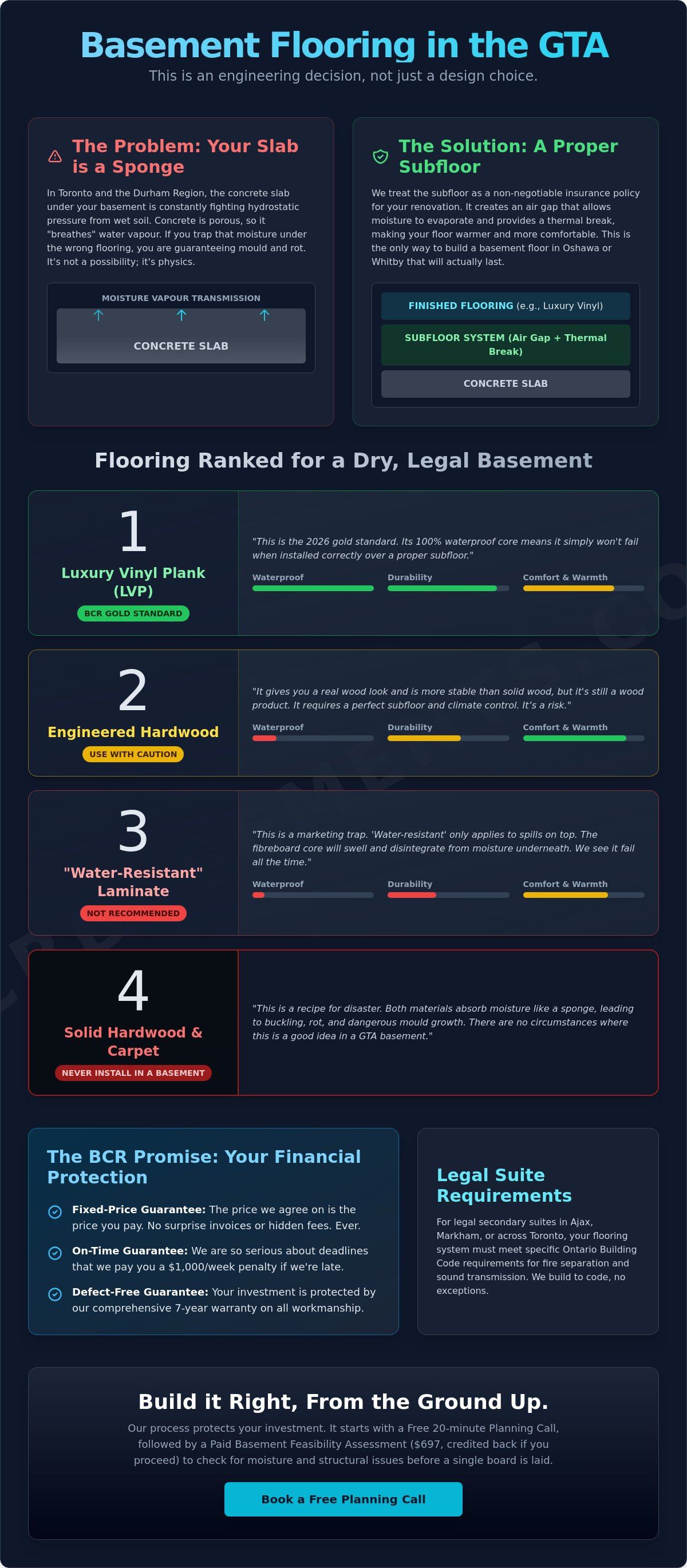
Hydrostatic pressure is the force of water in the soil pushing against your basement slab. This pressure can force water vapour through the pores of the concrete, which eventually breaks the adhesive bond of glue-down floors. Many big-box retailers in Whitby push "water-resistant" laminates, but this is often a marketing trap. Water-resistant means the top can handle a spill; waterproof means the core won't swell when moisture attacks from underneath. We always recommend a dedicated vapour barrier or a raised subfloor to prevent mould growth. This is why our Paid Basement Feasibility Assessment is a non-negotiable first step. We check these conditions before you spend a cent on basement flooring. It's about protecting your budget from hidden structural issues.
Temperature and Comfort Factors
The ground temperature in the Durham Region stays consistently cold, which turns your concrete slab into a giant heat sink. If you install porcelain tile directly on the slab, it will feel like ice underfoot during a January cold snap. Luxury Vinyl Plank (LVP) offers a better thermal break, especially when paired with a high-quality underpad. A warmer floor doesn't just feel better; it improves your HVAC efficiency. When your floor stays at a reasonable temperature, your basement heater doesn't have to fight the constant chill of the earth. We focus on these structural details because they ensure your investment lasts for decades, not just until the next season change. This pragmatic approach is why we back our work with a 7-year Defect-Free Guarantee and provide a Fixed-Price Guarantee to eliminate financial guesswork.
Building from the Concrete Up: Why Subfloors are Non-Negotiable
We view the subfloor as the insurance policy for your entire renovation investment. Laying your finish material directly onto concrete is a gamble that rarely pays off in the GTA. A proper subfloor system creates a critical air gap between the cold, porous slab and your finished living space. This gap allows incidental moisture to evaporate before it can feed mould colonies or warp your expensive new boards. It also provides a necessary thermal break that keeps your feet warm during a Markham winter. Without this layer, your basement will always feel like a basement, no matter how much you spend on decor.
When selecting basement flooring, homeowners often fixate on the aesthetics of the top layer. We focus on the structural logic underneath. A high-quality subfloor adds a layer of cushioning that makes the walking surface significantly softer on your joints. It also ensures your project aligns with the Ontario Building Code, which is vital when we are building legal secondary suites that require strict adherence to moisture and fire safety standards.
Popular Subfloor Systems for Toronto Basements
DMX 1-Step is a low-profile dimpled membrane that is perfect for Toronto homes where every centimetre of ceiling height matters. It provides moisture protection without the bulk, making it a staple for modern basement flooring installations. DRIcore panels, conversely, offer a structural wood feel that mimics the upper floors of your home. They are more expensive and take up more height, but the comfort is unmatched. We also frequently use self-levelling compounds. Concrete slabs are almost never flat. In the Durham Region, professional subfloor levelling typically adds $2 to $4 per square foot to the total cost. This step is mandatory if you want your manufacturer’s warranty to hold.
The BCR Standard for Floor Preparation
Our preparation starts long before the first plank is laid. During our Paid Basement Feasibility Assessment, we test the concrete for moisture emission rates. We refuse to install over a compromised slab. If the floor isn't perfectly level, your vinyl planks will make a "clicking" sound and the locking joints will eventually snap. We insist on a level surface because our 7-year Defect-Free Guarantee is built on this foundation. We don't offer vague estimates that change halfway through the job. Our Fixed-Price Guarantee means we account for this preparation upfront so there are no surprise invoices. If you want to see how these structural requirements impact your investment, you can Use the Basement Cost Calculator at bcrdesignbuild.com to get a realistic starting point.
Comparing the Best Flooring Options for Toronto Basements
Luxury Vinyl Plank (LVP) is the gold standard for GTA basements in 2026. It has effectively replaced laminate as the default choice because it handles the moisture profile of a Toronto cellar without structural failure. For most professional installations in the Durham Region, you should budget between $8 and $18 per square foot for mid-to-high-range materials and labour. This range reflects the actual trade rates in our local market, which sit well above national averages. We recommend these materials because they align with our Fixed-Price Guarantee. We know exactly how they perform on a prepared slab, which prevents the surprise cost overruns common with inferior products.
Selecting the right material is a balance of your intended use and the structural reality of your home. A high-end home theatre has different requirements than a high-traffic rental suite. We help you navigate these choices during our Paid Basement Feasibility Assessment, ensuring the material you choose won't be ruined by a humid Ajax summer or a cold Scarborough winter.
Luxury Vinyl Plank (LVP): The All-Rounder
If you are building a legal basement apartment, 100% waterproof cores are essential. Look for Stone Plastic Composite (SPC) or Wood Plastic Composite (WPC) labels. These cores do not swell if your dishwasher leaks or the humidity spikes. For rental units or homes with pets in Whitby, the wear layer is your most important specification. A 20-mil wear layer provides the scratch resistance needed for long-term durability in a secondary suite. LVP is the easiest basement flooring to live with because it only requires a damp mop. It does not need the specialized cleaners or periodic refinishing that real wood demands.
Engineered Hardwood vs. Porcelain Tile
Engineered hardwood is the only way to get real wood in a basement safely. It features a cross-laminated plywood base that resists the expansion and contraction that ruins solid oak. We often install this in premium Pickering home theatres where the aesthetic must match the upper floors of the house. For basement bathrooms and laundry rooms, porcelain tile remains the most durable choice. It is completely impervious to water. However, it can cost upwards of $19 per square foot once you factor in professional thinset, grout, and the necessary floor prep. We strongly advise against carpet in any basement flooring project. Carpet acts as an allergen trap for dust mites and mould spores in below-grade spaces. It is a liability we prefer to avoid. If you want to see how these material choices impact your total investment, you can use the Basement Cost Calculator at bcrdesignbuild.com to get a realistic breakdown for your postal code.
Legal Suite Requirements: Flooring and the Ontario Building Code
Converting a basement into a legal rental in Toronto isn't just about floor plans and kitchens. The Ontario Building Code mandates specific performance standards for your basement flooring to ensure life safety and occupant comfort. If your materials don't meet fire and sound ratings, your occupancy permit will fail. We see homeowners in Ajax and Whitby lose thousands because they chose materials that look good but don't comply with provincial safety standards. Compliance is non-negotiable.
Soundproofing Between Units
Sound Transmission Class (STC) ratings measure how well a floor assembly stops noise from travelling between units. For a legal suite, your floor must act as a buffer against both airborne noise and impact noise like heavy footsteps. Thick Luxury Vinyl Plank is significantly better than porcelain tile for reducing impact noise because it absorbs energy rather than reflecting it. The right underlayment is your secret weapon here. It provides the necessary acoustic break to keep your tenants happy and your suite legal. You can find more on navigating these regulations in our Toronto Basement Renovation Checklist. We build these requirements into our planning phase to avoid inspection delays.
Fire Safety and Material Ratings
Your flooring choice directly impacts the smoke-tight requirement for suite separation. The Ontario Building Code requires a fire-rated assembly between the main dwelling and the basement apartment, often necessitating a 45-minute fire rating. We only use materials that meet strict flame spread and smoke-developed classifications. This is a critical safety detail that many budget contractors overlook. During our Paid Basement Feasibility Assessment ($697, credited back if you proceed), we verify that your planned finishes meet all local Durham Region bylaws. This upfront check protects your investment and ensures your project passes every permit inspection in Whitby or Pickering. Our Fixed-Price Guarantee covers all code-compliant materials, so you never face surprise costs during the inspection stage. Book a free Planning Call at bcrdesignbuild.com to discuss your suite’s legal requirements.
Choosing Your Floor with the BCR Fixed-Price Guarantee
Most contractors provide a "placeholder" number for basement flooring that inevitably swells once the real work begins. We find this practice deceptive and unprofessional. Our Fixed-Price Guarantee means the cost on your contract is the final number. We account for every bag of self-leveller and every linear foot of transition strip before we start. This eliminates the financial anxiety that usually plagues GTA renovations. You deserve a partner who values financial predictability over a quick sale.
We also value your time as much as your budget. The BCR Promise includes an On-Time Guarantee; if we finish your project late, we pay you $1,000 for every week of delay. This creates a level of accountability that is rare in the Durham Region. Our 4.7-star rating across 43 verified Google reviews exists because we treat your project with structural logic and financial discipline. We don't guess; we plan. It is the only way to ensure a renovation doesn't turn into a nightmare.
The BCR Selection Process
We integrate flooring selection into our Paid Basement Feasibility Assessment ($697). This assessment is credited back if the project proceeds, but its primary purpose is to protect your investment from the start. We help you select materials that maximize basement for rent in toronto yields by choosing finishes that attract high-quality tenants. Durable, moisture-resistant choices like SPC vinyl ensure your rental income isn't eaten up by constant repairs. Our 7-year Defect-Free Guarantee means we stand by the integrity of the installation long after the tenants move in. This is about building a long-term asset, not just a temporary fix.
Start Your Flooring Project Today
You shouldn't have to guess about moisture risks or square foot costs in Oshawa or Whitby. We provide the data you need to make an informed decision. Stop relying on vague estimates that aren't designed to hold. Use the Basement Cost Calculator at bcrdesignbuild.com to get a realistic sense of current GTA rates. Once you have your numbers, book a free 20-minute Planning Call at bcrdesignbuild.com to discuss how we can turn your basement into a high-value asset. We are ready when you are.
Secure Your Basement Investment
Choosing basement flooring in the GTA is a decision that impacts your home's structural integrity and your long-term budget. You now understand why a subfloor is non-negotiable and how the Ontario Building Code dictates your material choices for a legal suite. Don't leave these critical details to a contractor who relies on vague estimates that change once the work starts. We eliminate that financial uncertainty with our Fixed-Price Guarantee and protect your investment with a 7-Year Defect-Free Warranty. Our 4.7-star rating across 43 verified Google reviews is the direct result of this disciplined, no-nonsense approach.
We prioritize your long-term peace of mind over a quick sale. If you're ready to build a space that is both legal and durable, the next step is a data-driven plan. Book a free 20-minute Planning Call at bcrdesignbuild.com to discuss your project's feasibility. We look forward to helping you realize a basement that actually works for your family and your financial goals.
Frequently Asked Questions
What is the absolute best flooring for a basement that might leak?
Porcelain tile is the only material that is truly impervious to standing water. If your basement in Toronto has a history of seepage, tile or finished concrete are your only viable options. Waterproof vinyl plank (SPC) handles high humidity and minor spills, but it won't survive a major flood where water gets trapped underneath the planks. We assess these specific environmental risks during our Paid Basement Feasibility Assessment to ensure your material choice is logically sound.
Do I really need a subfloor if I am using waterproof vinyl plank?
You need a subfloor to provide a thermal break and a moisture management system. Even if the vinyl itself is waterproof, the concrete slab is not. A subfloor like DMX or DRIcore creates a necessary air gap that allows the slab to breathe and prevents mould from forming in the dark space between the vinyl and the concrete. It also makes your basement flooring significantly warmer underfoot during a cold Whitby winter.
How much does basement flooring installation cost in the GTA in 2026?
Professional installation for mid-range basement flooring typically costs between $8 and $18 per square foot in the GTA. This range includes high-quality materials, professional labour, and basic floor preparation. Porcelain tile is more expensive, often reaching $19 per square foot once you factor in the complexity of the installation and required thinset. These rates reflect current 2026 Durham Region trade costs, which sit well above national averages.
Can I put laminate flooring directly on concrete?
Putting laminate directly on concrete is a guaranteed way to waste your money. Concrete wicks moisture that will cause the wood-fibre core of the laminate to swell and buckle within a single season. If you insist on laminate in an Oshawa basement, you must use a high-quality vapour barrier or a raised subfloor system. We generally advise against laminate in favour of 100% waterproof vinyl to avoid these predictable structural failures.
What flooring is required by the Ontario Building Code for a legal basement apartment?
The Ontario Building Code does not specify a flooring material, but it does mandate fire separation and sound transmission class (STC) ratings. If you are building a legal basement apartment, your floor assembly must help prevent the spread of fire and dampen noise between units. We ensure all our flooring installations meet these strict regulatory requirements during the permit process in Toronto and Scarborough to ensure your suite is compliant.
Is engineered hardwood safe for a basement in Toronto?
Engineered hardwood is safe for basements provided you have a dry, climate-controlled environment. Its cross-laminated construction makes it more stable than solid wood, so it won't warp as easily when humidity levels shift between Ontario summers and winters. We often install this in premium Pickering home theatres. However, it is not waterproof. If your basement has any history of moisture issues, we will always steer you toward a more durable material.
How long does it take to install flooring in a 1,000 square foot basement?
Installing flooring in a 1,000 square foot basement usually takes between three and five business days. This timeline includes essential floor preparation like self-levelling and installing the subfloor system. We don't rush this process because the foundation must be perfect for the finish to last. Our On-Time Guarantee ensures we hit our agreed milestones or we pay you $1,000 for every week of delay.
Why is my basement floor so cold and can new flooring fix it?
Your floor is cold because the concrete slab is in direct contact with the cold earth, acting as a thermal bridge that pulls heat from the room. You can fix this by installing a subfloor and a material like Luxury Vinyl Plank, which provides a significant thermal break. This combination keeps the heat in your finished space and makes the floor comfortable enough to walk on in your socks during a January cold snap in Ajax.