



.svg)

11 min read
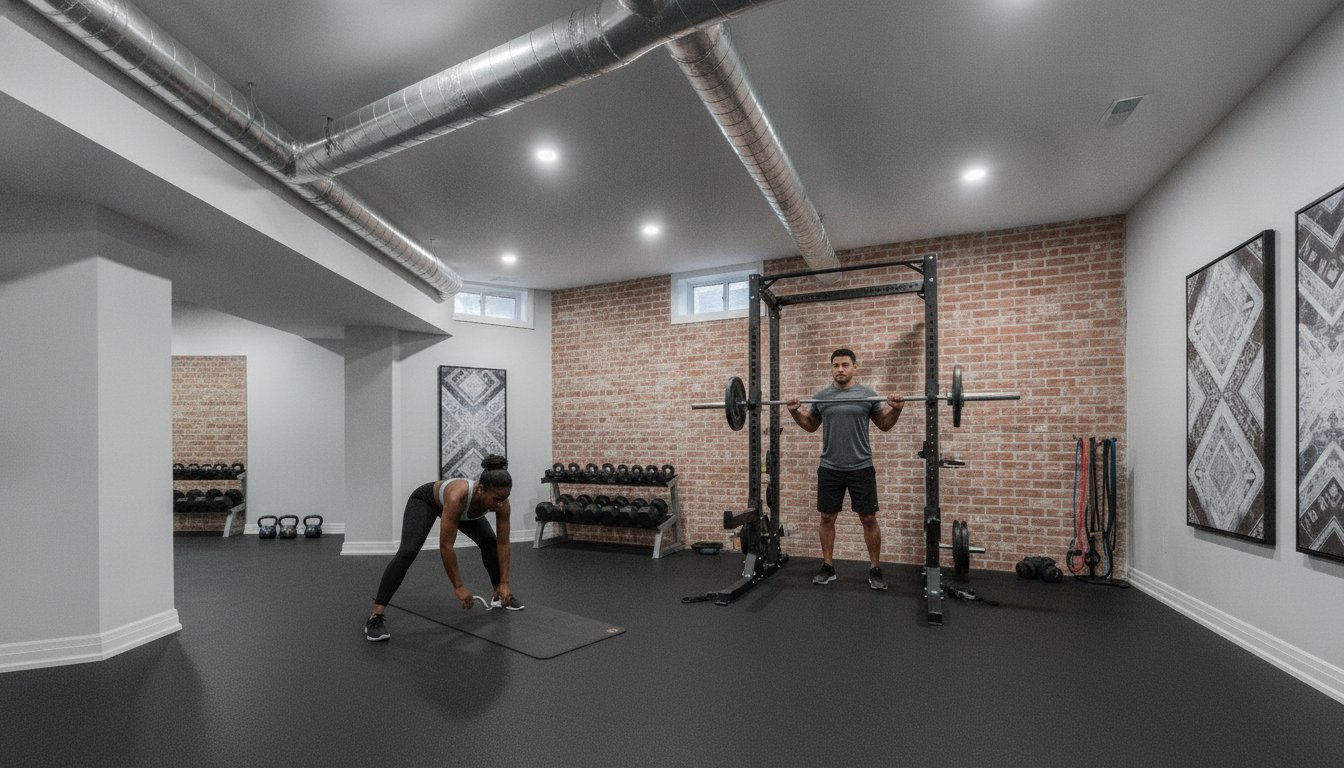
Most contractors will tell you a basement gym is just a flooring swap and some paint. They're wrong. If you live in an older home in Toronto or the Durham Region, you're likely fighting low ceiling heights and poor air flow that make serious training impossible. We understand the anxiety of investing in a space only to have it feel damp, loud, and cramped.
We're here to show you how to transform that underutilized area into a professional-grade fitness centre using structural and environmental engineering. You'll learn how we navigate 2026 Ontario Building Code standards for ceiling heights and ventilation while ensuring your project stays on budget. We're covering everything from moisture management in Oshawa to noise dampening in Whitby, all backed by the BCR Promise of fixed-price certainty. It's time to stop treating your health as a DIY project and start following a structured plan that accounts for everything from $1,500 permit fees to high-performance air exchange. This guide moves you from a state of worry to a state of informed confidence regarding your home investment.
Key Takeaways
- Identify the structural modifications needed to meet 2026 Ontario Building Code height requirements in older GTA basements.
- Learn why engineering proper ventilation is non-negotiable for keeping a basement gym free of mould and persistent odours.
- Compare subfloor systems like DRIcore to see how they provide essential joint protection and sound dampening over raw concrete.
- Evaluate the electrical load of high-draw cardio machines to determine if your space requires a dedicated circuit.
- Discover how the BCR Promise eliminates financial anxiety with a Fixed-Price Guarantee and a penalty-backed timeline.
Evaluating Your Basement Structure for a Professional Gym
Stop trying to perform burpees or overhead presses in a space meant for seasonal storage. Most basements in the GTA, especially in older neighbourhoods like Scarborough or Toronto, lack the vertical clearance for a true professional setup. We look for a minimum of 7 feet of clearance, though 8 feet is the gold standard for high-performance training. If your ceiling is lower, you're not just cramped; you're limited in the types of exercise equipment you can safely install. A standard power rack alone often stands 84 inches tall, leaving zero room for pull-ups if your joists are too low.
Structural integrity is the first thing we check. Your concrete floor isn't indestructible. A standard 3-inch slab in an older home in Ajax or Pickering might crack under the concentrated impact of a 500-pound deadlift or a heavy leg press machine. We verify the slab thickness and soil compaction before any equipment arrives. This isn't about aesthetics. It's about ensuring your foundation doesn't fail under your fitness goals.
To better understand the physical requirements of a functional space, watch this helpful video:
Ceiling Height and Underpinning Solutions
If you're stuck with a 6-foot ceiling, you have two real choices: change your workout or change your house. Underpinning allows us to dig out the floor and gain 2 to 3 feet of vertical space. It's a major engineering project that requires a structural permit and precise execution. In areas like Whitby or Oshawa, where soil conditions vary, we sometimes suggest bench-footing. It's a faster way to gain height without digging beneath the existing footings. You'll lose a bit of floor perimeter, but you gain the height needed for a treadmill or a functional trainer without hitting your head on a duct.
Structural Load and Equipment Weight
Heavy machinery and weight racks require a stable base. We assess the load-bearing capacity of your concrete and identify if floor joists need reinforcement for ceiling-mounted TRX straps or heavy bags. This structural logic is a core part of our Paid Basement Feasibility Assessment ($697). We don't guess. We use data to ensure your basement gym is safe for high-intensity use. Toronto permit fees for these alterations are currently $11.09 per square metre, and we factor every cent of that into our Fixed-Price Guarantee. You get certainty, not a list of "unexpected" structural costs. Use the Basement Cost Calculator at bcrdesignbuild.com to see where your budget stands before we start digging.
Managing Air Quality and Humidity in High-Intensity Spaces
Sweat is a pollutant in a confined space. If you're doing high-intensity interval training in a Markham basement, you're pumping litres of moisture into an environment that is already naturally damp. Standard residential HVAC systems are designed for general comfort. They aren't built for the humidity spikes of four people on treadmills. Relying on a single return air vent is a recipe for mould and that lingering "old gym" smell that never leaves your drywall.
A professional basement gym requires dedicated air exchange. Opening a window in a Whitby basement in mid-July doesn't help. It just lets in more humid Ontario air. We focus on mechanical ventilation and professional-grade dehumidification systems that move stale air out and replace it with filtered, conditioned air. This protects your health and your home's structure.
Upgrading HVAC for Increased Ventilation
Standard furnaces don't handle the latent heat and moisture of a workout well. We often recommend an Energy Recovery Ventilator (ERV). This system exhausts stale, humid air while pre-conditioning the fresh air coming in. It keeps your heating bills in Pickering stable while ensuring you aren't breathing in recycled CO2. We also look at modifying your ductwork to ensure the gym has its own supply and return. This prevents gym odours from being pumped into your main-floor kitchen. It’s also critical to start with waterproofing basement walls so your ventilation system isn't fighting external water ingress. Following the latest Ontario Building Code updates, we ensure your mechanical systems are sized for the actual usage of the room, not just the square footage.
Moisture Control and Foundation Integrity
Moisture management starts behind the mirrors. Before we install any equipment, we inspect for foundation cracks or efflorescence. These are signs of water pressure that will eventually destroy your finishes. Vapour barriers are non-negotiable in an Ontario basement. We use high-grade barriers to stop moisture from the ground from reaching your studs. If you're seeing condensation on your equipment, your system is already failing. We include these environmental assessments in our feasibility phase to ensure your gym doesn't become a mould factory. You can book a free Planning Call to discuss how we handle these environmental factors before you commit to a build.
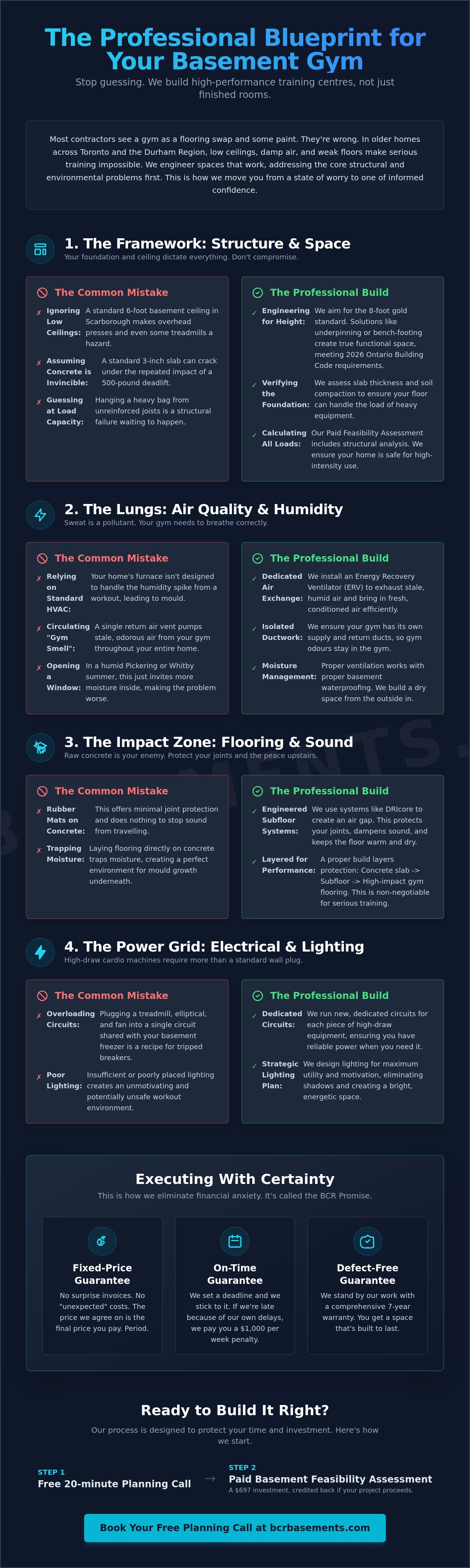
Engineering the Floor for Impact and Sound Protection
Throwing rubber mats onto raw concrete is a common mistake. It might work for a garage in Oshawa, but in a professional basement gym, it leads to joint pain and noise complaints. Concrete has zero "give." Every pound you lift or jump you take sends that force back into your knees and ankles. A proper build starts with a decoupled subfloor system to absorb impact and protect your foundation from the vibration of heavy weights.
Flooring choice is the single biggest variable in your daily comfort. If the floor is too hard, you won't use the space. If it's too soft, your equipment will be unstable. We realize that a high-performance space requires a layered approach that balances stability with shock absorption. This isn't just about the top layer you see; it's about the engineering happening underneath.
Subfloor Systems for Concrete Foundations
GTA basements are cold and prone to moisture. A raised subfloor, such as DRIcore or a custom plywood sleeper system, creates a vital air gap between the concrete slab and your gym floor. This gap wicks away moisture and provides a thermal break. It keeps your feet warm during a Markham January and prevents mould from forming under your mats. For a deep dive into how these systems compare, check our basement flooring guide. We prioritize these systems because they extend the life of your equipment and your joints.
Impact Protection and Sound Dampening
Noise transfer is the most common regret we hear from homeowners in Whitby or Toronto. If you're dropping weights or running on a treadmill, the vibrations travel through the floor and up the walls. We recommend high-density rubber flooring between 8mm and 12mm thick. Anything thinner is just for looks and offers no real protection. To truly isolate the sound, we look at the ceiling too. Drywall acts like a drum; dropped ceiling tiles or strategic acoustic insulation can stop the noise from reaching the bedrooms above. We include these sound-dampening strategies in our Paid Basement Feasibility Assessment ($697) to ensure your 6:00 AM workout doesn't wake the whole house. It’s about building a space that works for your entire family, not just your fitness goals. If you want to see how these materials impact your budget, use the Basement Cost Calculator at bcrdesignbuild.com.
Planning Electrical and Lighting for Maximum Utility
Plugging a commercial-grade treadmill into a shared 15-amp circuit is a mistake. You'll trip the breaker the moment you hit a high-intensity interval. A professional basement gym in Markham or Toronto requires a dedicated 20-amp circuit for the treadmill alone to prevent mid-workout power failures. We calculate the specific amperage requirements for your entire equipment list. This includes everything from motorized incline systems to high-fidelity soundbars. Technical foresight ensures your home's electrical panel isn't overstressed by your fitness goals.
Safety depends on precise outlet placement. We position power points directly behind where your machinery will sit. This eliminates the need for extension cords and removes dangerous trip hazards from your floor space. It keeps the area clean and organized. We don't guess on load requirements; we use data to plan your infrastructure. This is why we insist on a Paid Basement Feasibility Assessment ($697) to verify your current panel capacity before any drywall is touched.
Electrical Planning for Cardio and AV
A standard treadmill can draw significant power, often peaking at 15 amps during heavy use. When you add a 4K display and a dedicated sound system, you're well beyond what a standard bedroom circuit can handle. We organize all Electrical Safety Authority (ESA) permits for these upgrades to ensure your build is legal and safe. Smart home integration is another standard for our builds. We can install voice-controlled lighting and climate systems. This allows you to adjust the environment without stepping off the equipment. It simplifies your routine and keeps your focus on the workout.
Lighting Design and Aesthetic Motivation
Dim, yellow lighting belongs in a lounge, not a gym. We use LED fixtures in the 4000K to 5000K range to mimic natural daylight. This colour temperature keeps you alert and improves your visibility for complex lifts. Mirror placement is equally functional. We align mirrors to maximize light reflection and provide clear sightlines for form correction. This turns a windowless basement in Pickering or Whitby into a bright, high-energy environment. For more tips on avoiding common project pitfalls, see our basement renovation checklist. You can Book a free Planning Call at bcrdesignbuild.com to ensure your electrical panel is ready for the load.
Executing Your Vision with the BCR Promise
Building a basement gym is a significant investment that deserves more than a vague handshake agreement. Most contractors in the GTA provide quotes designed to change once the walls are open. We don't operate that way. We provide financial predictability through the BCR Promise. This isn't a marketing slogan; it's a set of three written guarantees that protect your budget and your time. We take the anxiety out of the construction process by shifting the risk from your shoulders to ours.
Our Fixed-Price Guarantee means the number on your contract is the number on your final invoice. If we miss a structural detail or an electrical requirement during the planning phase, that's our cost, not yours. We also include an On-Time Guarantee. If we finish late, we pay you a $1,000 penalty for every week of delay. Finally, our 7-year Defect-Free Guarantee ensures your high-intensity space stands up to years of heavy use. We stand by our work because we've spent over 20 years refining our process in the trades. This level of honesty distinguishes us from contractors whose quotes are never designed to hold.
The Paid Basement Feasibility Assessment
We don't offer "free estimates" or "free quotes" because they are fundamentally inaccurate and lead to project delays. A professional-grade basement gym requires a detailed analysis of your home's structure and mechanical systems. Our Paid Basement Feasibility Assessment ($697) is a non-negotiable starting point that eliminates financial guesswork. We spend hours on-site and in planning to ensure your project is viable before you commit significant capital. When you decide to move forward, we credit that $697 back to your project. It's a benefit that ensures your investment is based on data, not hope. This process protects your time and ensures we don't start a project that isn't structurally sound.
Local Expertise in Durham Region and the GTA
Navigating building codes in Whitby, Ajax, or Toronto requires more than just general labour. We understand the specific permit requirements for structural alterations and fire separations in the Durham Region. Our 4.7-star rating across 43 verified Google reviews reflects our commitment to these professional standards. We target a level of precision that "lowest-bid" contractors simply cannot match. We are the rational voice in a chaotic industry. If you value certainty and structural logic over the lowest price, we are the right partner for your build. We prioritize long-term investment over a quick sale every time. It’s about building a space that adds real value to your home and your health.
Book a free Planning Call at bcrdesignbuild.com.
Securing Your Home Fitness Investment
Building a professional basement gym in the GTA is more than an aesthetic choice; it’s a complex engineering project that requires structural foresight. We've covered why vertical clearance, moisture management, and dedicated electrical circuits are the non-negotiable pillars of a high-performance space. You now understand that skipping the subfloor or ignoring HVAC requirements leads to long-term property damage and wasted capital. We don't believe in the vague estimates common in the trade.
We eliminate the risks associated with financial uncertainty. Our Fixed-Price Guarantee, On-Time Guarantee with a $1,000 per week penalty, and 7-year Defect-Free Warranty provide the certainty you need to proceed. We don't rely on guesswork; we rely on a structured process that prioritizes your home’s integrity and your budget. It's time to move from a state of worry to a state of informed confidence regarding your project viability.
Book a free 20-minute Planning Call at bcrdesignbuild.com
We look forward to helping you build a fitness centre that works as hard as you do.
Frequently Asked Questions
Do I need a building permit for a basement gym in Toronto?
You need a permit if your project involves structural changes, such as removing load-bearing walls or underpinning, or if you're modifying plumbing and electrical systems. In Toronto, the 2026 fee for interior alterations is $11.09 per square metre. We manage the entire permit application process; including the required architectural drawings which typically cost between $2,000 and $5,000 in the GTA.
How much does it cost to build a professional basement gym in the GTA?
Market averages for basement finishing in the Durham Region or Toronto range from $35 to $95 per square foot. A professional-grade gym often sits at the higher end of that scale because it requires specialized subfloors, reinforced joists, and dedicated HVAC systems. We provide a Fixed-Price Guarantee after our Paid Basement Feasibility Assessment ($697) to ensure your specific project budget never fluctuates once construction starts.
Is underpinning necessary for a basement gym if my ceilings are low?
Underpinning is necessary if your current height prevents safe movement or the installation of standard power racks. If you have less than 7 feet of clearance, you'll struggle with overhead movements or pull-ups. While bench-footing is a cost-effective alternative for gaining height in Whitby or Oshawa homes, underpinning is the gold standard for creating a seamless, professional-height fitness centre.
How do I prevent my basement gym from smelling like a locker room?
You must install an active ventilation system like an Energy Recovery Ventilator (ERV) to exhaust humid, stale air and bring in fresh, conditioned air. Standard residential bathroom fans are insufficient for the moisture generated during a high-intensity workout. Proper air exchange prevents mould growth and keeps the air fresh. We prioritize these mechanical systems during our feasibility phase to protect your home's air quality.
What is the best flooring for a basement gym over concrete?
The best setup is a moisture-wicking raised subfloor topped with 8mm to 12mm high-density rubber mats. We don't recommend placing rubber directly on concrete because it traps moisture and offers poor thermal insulation. A system like DRIcore provides the necessary air gap to keep your basement gym floor dry and warm during cold Ontario winters while protecting your joints from impact.
Can I install a sauna or steam room in my basement gym?
Yes, but it requires significant upgrades to your moisture management and electrical systems. Adding a sauna involves high-draw electrical circuits and specialized vapour barriers to prevent steam from migrating into your wall assemblies. This is a common request in Markham and Pickering; however, it must be engineered correctly from the start to avoid future rot and structural damage.
How long does a typical basement gym renovation take to complete?
A standard project usually takes between 6 and 10 weeks depending on the structural scope and permit timelines. If we're performing underpinning or major HVAC modifications, the timeline extends toward the longer end. We provide a clear, written schedule before construction begins so you aren't living in a construction zone longer than necessary.
What happens if my renovation project goes over the scheduled time?
We pay you a penalty of $1,000 for every week we are late through our On-Time Guarantee. This keeps us accountable and ensures your project remains our priority. We value your time as much as your investment. We don't believe in the "missing contractor" syndrome common in the GTA; we put our own money on the line to prove it.